


Ford Work Vans for Dodge County Contractors: How to Spec a Transit for Your Trade
If you run a trade business out of Beaver Dam, Juneau, Mayville or anywhere else in Dodge County, the van is not a vehicle purchase. It is a piece of equipment that determines how many calls you can run in a day.
Most contractors get one of three things wrong when they order: the roof height, the drivetrain, or the upfit plan. Here is how to think through each one before you sign an order.
First, the Transit Connect question
Ford stopped selling the Transit Connect new in the United States after the 2023 model year. The entire compact van segment has effectively left the US market, and Ram, GM, Nissan and Mercedes all exited before or around the same time.
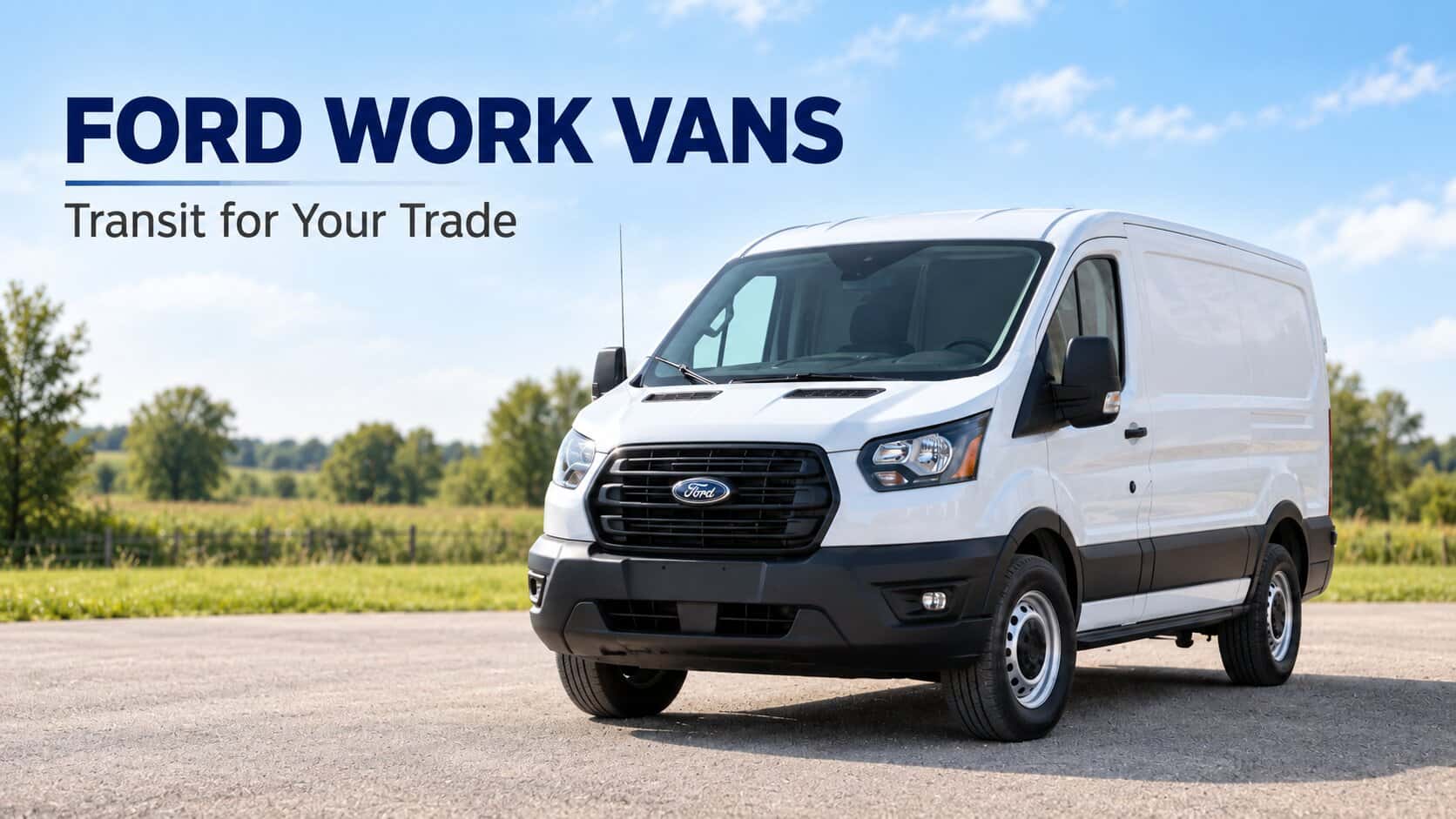
So if you were planning on a Connect, your realistic options now are a used one, a low roof regular length Transit, or a Maverick or Ranger with a cap or bed rack. For most trades, the low roof short wheelbase Transit is the closer replacement. It is longer than a Connect but still fits a standard residential garage.
Everything below covers the full size Transit, which is what Ford builds for work today.
The three decisions that actually matter
1. Series: how much weight are you carrying?
The Transit comes as T-150, T-250, T-350 and T-350 HD. The number refers to gross vehicle weight rating, which sets your payload ceiling.
A common mistake is speccing a T-150 and then loading it with a full shelving package, a stocked parts inventory, copper, fittings and two people. That adds up faster than most people estimate. Shelving alone can eat several hundred pounds before you put a single tool in it.
Check the payload sticker on the door jamb of the actual van you are considering. That number is specific to that vehicle and already accounts for the drivetrain and body you chose. It is the only payload figure that matters.
2. Roof height: can you work standing up?
Ford offers low, medium and high roof.
Low roof fits most standard residential garages, which matters if you park at home. You will be crouching or working out of the back doors.
Medium roof gives standing room for shorter operators and clears most commercial overhead doors.
High roof gives full standing room for most adults. This is the right answer for plumbers, electricians and HVAC techs who assemble, cut and stage parts inside the van. It is also the configuration most likely to exceed a residential garage door.
Measure your garage and your shop door before you order. High roof Transits approach or exceed the clearance on a lot of older Dodge County garages and pole sheds.
3. Length: how long is your longest material?
Cargo vans come in regular, long and extended long, built on 130 inch and 148 inch wheelbases.
The question is simple: what is the longest thing you carry inside, and does it need to lay flat? Ten foot sticks of conduit, sheet goods and long duct runs push you toward the longer body. If you mostly carry service parts and tools, the shorter van maneuvers better in farm driveways and tight residential lots.
Factory trade packages worth asking about
Ford builds trade-specific packages into the Transit order guide, which means the shelving and storage come installed from the factory and are covered accordingly.
The current lineup includes packages configured for electricians, HVAC contractors and general contractors. Each one sets up bins, shelving and storage around how that trade actually works, so the electrician package is laid out for wire, fittings and hand tools while the HVAC package accounts for copper, parts and service gear.
Availability varies by roof height, length and series, and the packages change year to year. Ask us to confirm what is available on the configuration you want before you commit to a body style.
All wheel drive in Dodge County
Intelligent AWD is available on the Transit and integrates without raising the load floor or the seat height, so you do not give up cargo dimensions to get it.
Here is the honest case for it. An empty rear wheel drive cargo van has very little weight over the drive wheels. That is a real traction problem on a drifted county road in January, on an unplowed farm lane, or on a jobsite that has been churned to mud. If your work takes you off the highway and onto gravel and farm roads around Horicon, Juneau or Randolph, AWD earns its cost the first winter.
If you run a delivery or service route that stays on plowed pavement between Beaver Dam, Watertown and Columbus, rear wheel drive with weight in the back and a good set of tires may be all you need.
One note on ordering: AWD is generally tied to the EcoBoost engine rather than the base V6, so it affects your powertrain choice too.
Cold weather options worth checking the box on
These are cheap at order time and expensive to add later.
Engine block heater. If the van sits outside overnight, this is not optional in Wisconsin. Plug in for a couple of hours before you start and you get heat faster, cleaner starts and less wear.
Auxiliary heater. If you or your crew work out of the cargo area in winter, an auxiliary heater for the rear makes a meaningful difference on a long service day.
Pro Power Onboard. The Transit offers an onboard power system that runs tools directly off the van. For a service tech who currently drags a generator to every remote call, this replaces a piece of equipment and the fuel that goes with it.
Heavy duty battery and alternator. If you are running a liftgate, an inverter, an aux heater and a lot of upfit electrical, talk through the charging system before you order.
Does an E-Transit make sense here?
For some Dodge County businesses, yes. For a lot of them, not yet. The answer comes down to your daily radius and where you park at night.
The E-Transit runs an 89 kWh battery with an estimated range of up to 159 miles and DC fast charging up to 115 kW. For 2026 it gained a standard vapor injected heat pump, which is specifically aimed at holding range in cold weather.
That said, real world range drops when the van is fully loaded, when you are running highway speeds, and when it is cold. Plan around a number well below the estimate in January, not the estimate itself.
The practical test:
- You return to the same shop or home every night and can charge there. This is the requirement, not a nice to have. Public charging in Dodge County is thin.
- Your daily route stays comfortably under 100 miles. A plumber or electrician working a local service radius often fits this easily. A contractor running Madison and Milwaukee jobs in the same week usually does not.
- You idle a lot. Electric is strongest where a gas van burns fuel sitting still.
If it is close, run one E-Transit alongside your gas vans for a season before converting anything else. That is what most fleets do and it is a reasonable way to find out.
Upfitting: factory, Ford Pro, or aftermarket
You have three paths, and they are not mutually exclusive.
Factory trade packages are the simplest. The van shows up ready to work.
Ford Pro Upfit Integration System lets upfitters connect powered equipment to the vehicle without splicing into the electrical system or adding aftermarket modules and switch panels. If you are adding a liftgate, a crane, a compressor or anything that draws real power, this matters. It keeps the install clean and keeps the vehicle’s systems aware of the equipment.
Aftermarket upfitters give you the most customization. Ladder racks, partitions, custom shelving, pipe vises and specialty storage all come from this world.
The thing to avoid is ordering the van first and thinking about the upfit second. Roof height, length and series all constrain what your upfitter can do. Bring your upfit plan to the order conversation.
What Ford Pro adds after the sale
Ford Pro is the commercial side of the business, and for a small trade shop the useful pieces are these.
Telematics. Ford commercial vehicles have had embedded modems since 2020. Ford Pro Telematics gives you GPS location, vehicle health alerts, diagnostic codes, odometer readings and maintenance scheduling in one dashboard. Even for a two or three van operation, knowing a check engine light came on before your tech mentions it is worth something.
Mobile service. Ford Pro can bring routine service to your shop instead of you bringing the van to ours. For a business where a van in a service bay means a day of missed calls, that is the whole point.
Commercial service access. Dedicated commercial bays and extended hours exist so work vehicles are not sitting behind retail customers.
Commercial financing. Ford Pro offers financing structured for business purchases rather than retail buyers.
A note on writing it off
Business vehicle purchases may qualify for accelerated depreciation under Section 179 and bonus depreciation, and heavier vans often qualify differently than passenger vehicles do. The limits and rules change, and how much you can actually take depends on your business income and how the vehicle is used.
Talk to your accountant before you time a purchase around it. We can tell you the GVWR of a specific van, which is usually the number they will ask for first.
Before you come in, know these five things
- The longest material you carry inside, and whether it needs to lay flat
- Your realistic loaded weight, including shelving, stocked inventory and passengers
- Your garage and shop door height
- Your daily driving radius and how much of it is off pavement
- Your upfit plan, even a rough one
With those five answers, speccing the van takes about twenty minutes. Without them, most people order the wrong roof.
Summit Ford handles commercial orders and service for contractors around Beaver Dam and the towns nearby, including Juneau, Mayville, Horicon, Watertown, Columbus and Fox Lake. You can browse our commercial inventory here.
Frequently asked questions
Can I still buy a new Ford Transit Connect? No. Ford ended Transit Connect sales in the United States after the 2023 model year and the compact van segment has largely left the US market. Used Transit Connects are still out there, and the low roof regular length Transit is the closest new replacement for most trades.
Do I need all wheel drive on a work van in Wisconsin? It depends on where you drive. An empty rear wheel drive cargo van has limited traction because there is little weight over the drive wheels. If your work takes you onto gravel, farm lanes or unplowed roads, AWD is worth it. If you stay on plowed highways between towns, rear wheel drive with proper tires is usually sufficient.
Which roof height should a plumber or electrician get? High roof, in most cases, because it allows full standing work inside the van. The exception is if you park in a standard residential garage, since a high roof Transit will often exceed that clearance. Measure before you order.
How much can a Ford Transit carry? Payload varies significantly by series, body length, roof height and drivetrain. Check the payload sticker on the driver’s door jamb of the specific van, since that figure accounts for how that vehicle was built. Remember that shelving and stocked inventory count against it.
Is the E-Transit practical in a Wisconsin winter? It can be, for the right route. The 2026 E-Transit has a standard heat pump aimed at preserving cold weather range, but range still drops when the van is loaded and the temperature falls. It works best if you charge at your own shop or home and your daily route stays well under the rated range.
Can I get shelving installed before I take delivery? Yes. Ford offers factory trade packages for electrical, HVAC and general contracting work, and we can also coordinate with an upfitter. Bring your upfit plan to the ordering conversation, because roof height and body length affect what is possible.

0 comment(s) so far on Ford Work Vans for Dodge County Contractors: How to Spec a Transit for Your Trade